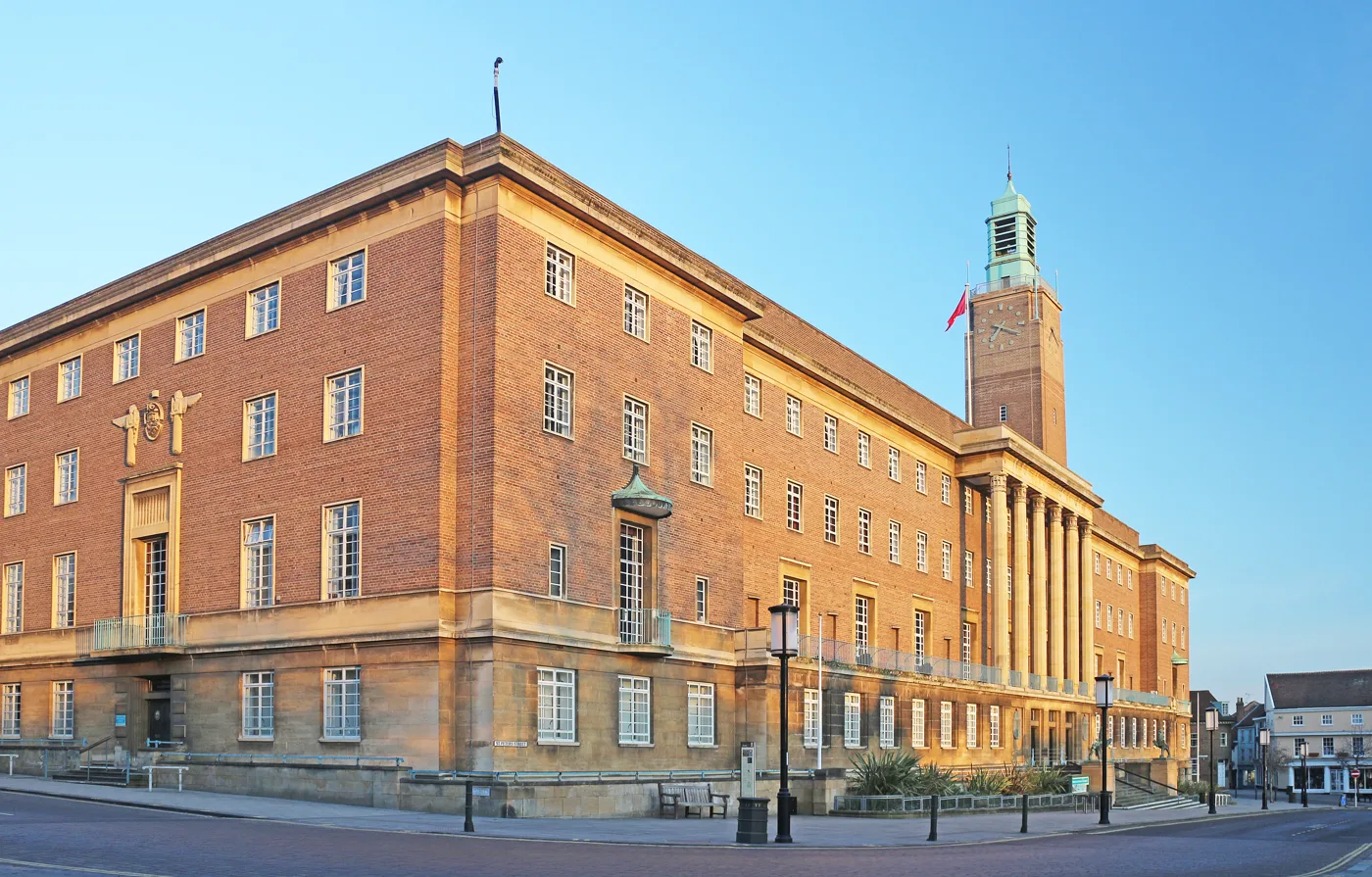

Norwich City Council is consulting until 24 January on licences for smaller HMOs citywide and rented homes in four wards. Fees would be up to £1,000.
Landlords across Norwich could need a council licence for smaller shared houses, at a proposed £1,000 a property. Privately rented homes in four wards would need one too, at £700. Norwich City Council opened a consultation on 2 November, and it closes on Sunday 24 January 2027.
No decision has been made. A report is expected to go to cabinet in spring 2027. Any approved scheme would not start before late summer 2027 and could run for up to five years.
What is proposed
There are two separate schemes, set out in the consultation documents:
- Additional licensing, citywide: houses in multiple occupation (HMOs) with three or four people forming two or more households and sharing facilities such as a kitchen or bathroom.
- Selective licensing, four wards: privately rented homes in Nelson, Mile Cross, Sewell and Town Close. Homes already covered by an HMO licence would not need a second one.
HMOs with five or more people already need a licence by national law. The council says about 1,200 are licensed now. It estimates there are 2,343 HMOs in the city, including about 1,137 smaller ones that the current rules do not reach.
What landlords would pay
The proposed fees come in two parts. Part A is due on application and is non-refundable once the application has been received and assessed. Part B is due once the council decides to grant the licence.
| Licence | Part A | Part B | Total |
|---|---|---|---|
| Additional (smaller HMOs) | £500 | £500 | £1,000 |
| Selective (four wards) | £350 | £350 | £700 |
- A landlord in an approved accreditation scheme would get £25 off Part B.
- A property with a valid EPC rated A to C would get another £25 off.
- Both together would bring the totals down to £950 and £650.
Over a full five-year licence, the standard fees work out at £200 and £140 a year, on our arithmetic. The council says the fees would only cover the cost of running the schemes, and that it cannot make a surplus. The figures may change after the consultation.
The evidence behind it
The council’s evidence summary says 20,330 of Norwich’s 69,441 homes are privately rented, or 29.3%. That is up from 23% in 2011.
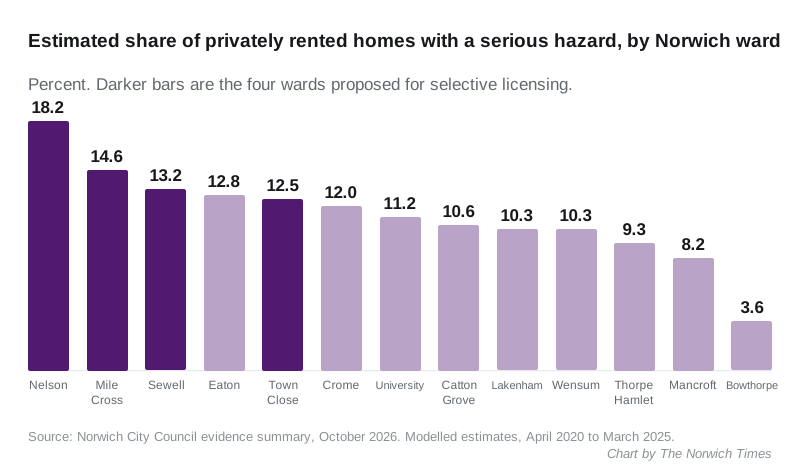
It estimates that 2,286 of those rented homes, or 11.2%, have at least one serious hazard. For HMOs the estimate is about 20%. These are modelled figures from a commissioned housing data report, not a count of homes that inspectors have visited.
Between April 2020 and March 2025 the council recorded:
- 670 complaints about privately rented homes
- 1,690 notices served on privately rented addresses
- 664 anti-social behaviour incidents at privately rented homes
The summary gives two different ward figures for anti-social behaviour, with University at 98 in one place and 426 in another, so we have not used the ward breakdown.
Which wards are in, and which are not
Three of the four chosen wards have the highest estimated hazard rates in the city. Town Close is fifth, just behind Eaton, which has far fewer rented homes.
Thorpe Hamlet and Mancroft have the most rented homes, but lower estimated hazard rates, and they are not in the selective scheme. Smaller HMOs in those wards would still be covered by the citywide scheme.
| Ward | Privately rented homes | Share of all homes | Estimated with a serious hazard | Hazard rate |
|---|---|---|---|---|
| Nelson (proposed) | 2,064 | 39.5% | 376 | 18.2% |
| Mile Cross (proposed) | 1,065 | 21.0% | 155 | 14.6% |
| Sewell (proposed) | 1,985 | 37.5% | 263 | 13.2% |
| Eaton | 823 | 17.6% | 105 | 12.8% |
| Town Close (proposed) | 1,878 | 33.4% | 235 | 12.5% |
| Crome | 714 | 13.5% | 86 | 12.0% |
| University | 1,271 | 28.9% | 142 | 11.2% |
| Catton Grove | 1,213 | 23.7% | 129 | 10.6% |
| Lakenham | 1,061 | 20.7% | 109 | 10.3% |
| Wensum | 1,409 | 25.5% | 145 | 10.3% |
| Thorpe Hamlet | 2,790 | 42.4% | 259 | 9.3% |
| Mancroft | 2,961 | 41.6% | 243 | 8.2% |
| Bowthorpe | 1,096 | 25.1% | 39 | 3.6% |
The four wards hold 6,992 privately rented homes between them, on our addition of the council’s figures. Not all would need a selective licence, because some are already licensed as HMOs.
Cllr Ian Stutely, the deputy leader and cabinet member for planning and regulatory services, said: “Private tenants should be able to get issues resolved quickly, and good landlords should have confidence that poor standards are being tackled.”
What it means for you
- If you rent: the draft conditions cover gas and electrical safety, smoke alarms and carbon monoxide detectors. The council would publish a list of licensed properties, so you could check your home. The FAQs do not say whether fees could feed through to rents.
- If you have a lodger: the FAQs say most people renting a room in their own home would not be affected.
- If you are a landlord: failing to license a covered property would be a criminal offence. The FAQs give the maximum civil penalty as £40,000 in one answer and £30,000 in another, so ask the council which applies.
- If you live nearby: the council says conditions may also cover waste and anti-social behaviour linked to a property. Neighbours can respond to the consultation too.
How to respond
The consultation closes on Sunday 24 January 2027. The project page prints 2026 in one place, but the council’s release and FAQs both say 2027.
- Online: the questionnaire is on Get Talking Norwich.
- Email: NorwichPRS@melresearch.co.uk
- Phone: 0800 073 0348
- Post: Freepost Plus RUBU-GJRK-GHBT, M E L Research Ltd, Somerset House, 37 Temple Street, Birmingham B2 5DP
For the latest rent and price figures, see our Norwich house prices story.
Have your say