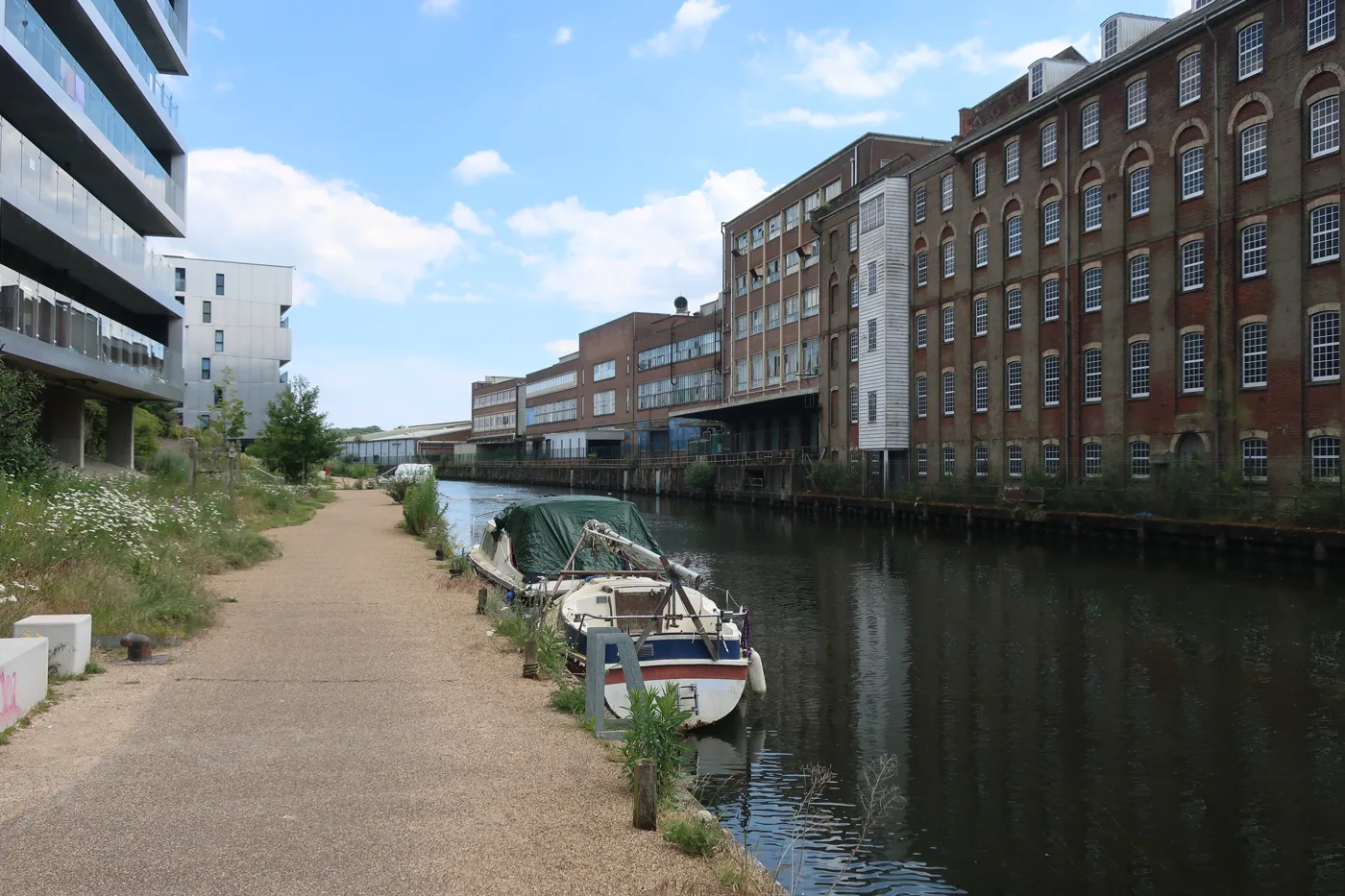

Homes England will show plans for up to 300 homes at the old Colman's works on 2, 3 and 6 October. The wider site has room for about 1,300 in all.
Residents will get their first look at what is planned for Carrow Works, the old Colman’s mustard factory, at three events in October. Homes England and Norwich City Council say the first phase at Carrow Works would be up to 300 homes on the riverside site.
The government’s housing agency announced the events on 17 September. It has also opened a consultation website, carrowsites.commonplace.is, which carries more detail than the announcement does.
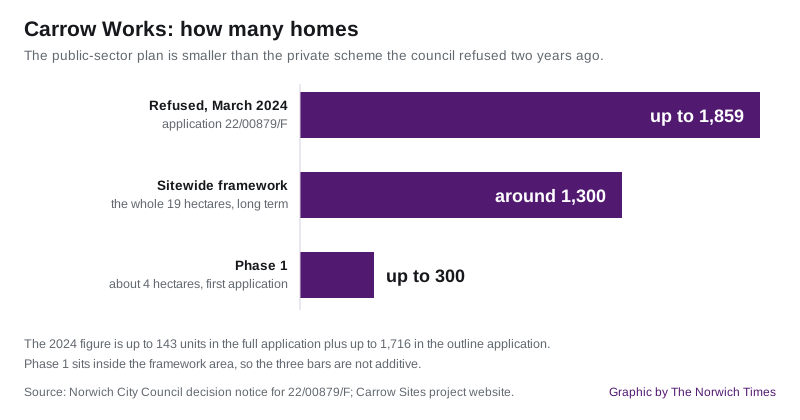
The number that matters most is on that website rather than in the press release. The sitewide framework covering the whole 19-hectare site has “space for around 1,300 homes”. The scheme a private developer applied for, and which the council refused in 2024, was up to 1,859.
Where and when to see the plans
Three drop-ins and one webinar, all in the first week of October:
- Friday 2 October, 2pm to 8pm, The Boardroom, Norwich City Football Club, Carrow Road
- Saturday 3 October, 10am to 2pm, Norwich Market
- Saturday 3 October, 10am to 2pm, lower ground floor at Chantry Place, opposite Boots
- Tuesday 6 October, 7pm to 8pm, online webinar, with registration through the project website
The council’s announcement listed two events and described the market as a stall. The project website lists all three as drop-ins. Either way, the Saturday sessions run at the same time in two places.
What is actually being proposed
Two things are being consulted on at once, and they are not the same size.
Phase 1 is the bit with a planning application behind it. It covers roughly 4 hectares at the south-east of the site, bounded by the railway, Bracondale and the Carrow Abbey grounds. The project team describes a mix of apartments and houses with open space, play areas, walking and cycling routes and some non-residential space. This will be the first detailed application on the site.
The sitewide framework is the longer-term plan for the whole 19 hectares. It is not an application. It sets out where movement, green space, infrastructure and heritage go, so that later phases fit together. Its stated capacity is around 1,300 homes.
The affordable housing promise has no number yet
This is the point worth taking to the drop-in.
The council’s announcement says the first phase “will include a high proportion of affordable housing”. The project’s own website is more careful. It says the Phase 1 proposals “will include affordable homes, with the final amount and type to be confirmed as the plans progress”.
Those are not the same statement. One is a promise about proportion, the other says the proportion is undecided.
It matters here more than on most sites, because affordable housing is one of the reasons the last scheme failed. When the council refused application 22/00879/F on 22 March 2024, its second reason for refusal said the housing mix, and particularly the predominance of flats, was not consistent with the Greater Norwich Local Housing Needs Assessment, and that “this along with the total lack of affordable housing results in an unsustainable housing development proposal”.
That application was made by Fuel Properties (Norwich) Ltd. The council gave 23 separate reasons for refusing it, covering connectivity, heritage harm, nutrient and recreational impacts on the Broads, access off the A1054 Bracondale, the absence of a site for a two-form-entry primary school and the absence of land for a health facility.
How the site ended up in public hands
Homes England completed its purchase of Carrow Works on 24 March 2026. It describes the site as 17 hectares. Norwich City Council owns neighbouring Carrow House, and the two are now being planned together as “Carrow Sites”, which is where the 19-hectare figure comes from.
It was the agency’s second large intervention in the city. The council noted at the time that Homes England had given it a £34 million grant in January 2025 to help buy Anglia Square.
The wider East Norwich area is 50 hectares, which the council calls the East of England’s largest brownfield site. The two organisations state its capacity slightly differently: Homes England says “up to 3,500 homes”, the city council says “over 3,500 new homes”.
What happens to the historic buildings
The project team says the approach is heritage-led. On the record so far:
- Carrow Abbey and Carrow House will be retained and brought back into use.
- The site contains the remains of a Benedictine priory, a Scheduled Monument, alongside historic landscape features and industrial buildings.
- The stated ambition is to open the site up with new paths, streets, squares and riverside connections. Much of it has been closed to the public for decades.
Heritage is the other place the 2024 scheme came unstuck. The council found “high levels of harm” to designated and non-designated heritage assets, which it judged was not outweighed by public benefit.
Who is drawing it
The project team is named on the consultation website: Haworth Tompkins as lead masterplanner, Hudson Architects on housing, Periscope on landscape, Quod on planning, Iceni on environmental impact assessment, heritage and archaeology, Buro Happold as technical lead and Oxbury on cost. Meeting Place is running the consultation and will analyse the responses.
One line on that website is worth reading twice. The city council is both a landowner and a partner in the scheme, and it is also the planning authority that will decide it. The website states that the council’s planning team “is independent of the teams’ developing proposals for the sites and will determine the planning applications submitted to them fairly and openly, as for any other applicant”.
What it means for you
If you live in Lakenham, Trowse, Thorpe Hamlet or along King Street, this is the consultation to turn up to. It is the stage before an application, which is the stage where layout, heights and access are still movable.
- Ask for the affordable number. “A high proportion” is not a percentage. The council’s own policy figure and the scheme’s viability position are the two things that decide it.
- Ask about the Bracondale access. Highway access off the A1054 was refused twice over in 2024, on design and on safety.
- Ask about the school and the health facility. Both were missing from the refused scheme, and neither has been mentioned in what has been published so far.
- If you cannot get to a drop-in, the webinar is on the Tuesday evening and the website takes comments directly.
There is no planning application to comment on yet. When one is submitted it will appear on the council’s register, and we track city applications on our Norwich planning news page.
Sources
- Public asked for their views on proposals for iconic mustard factory site, Norwich City Council, 17 September 2026, for the announcement, the “up to 300 homes” and “high proportion of affordable housing” wording, the quotes from Jayshree Patel of Homes England and Cllr Lucy Galvin, the event details and the “over 3,500 new homes” figure for the East Norwich Regeneration Area.
- Carrow Sites project website, Homes England and Norwich City Council, read on 21 September 2026, for the 19-hectare framework area, the approximately 4-hectare Phase 1 and its boundaries, the “space for around 1,300 homes”, the affordable housing wording, all four engagement events, the heritage commitments on Carrow Abbey, Carrow House and the Scheduled Monument, the named project team and the statement about the council’s planning team.
- Homes England secures key site in the heart of East Norwich, GOV.UK, 24 March 2026, for the completed acquisition, the 17-hectare site area and the “up to 3,500 homes” figure.
- Purchase of Carrow Works shows Norwich is mustard, Norwich City Council, 24 March 2026, for the £34 million Anglia Square grant of January 2025 and the 50-hectare East Norwich figure.
- Refusal of planning permission, application 22/00879/F, Norwich City Council, 22 March 2024, for the applicant, the up to 143 units in the full application and up to 1,716 in the outline, the 23 reasons for refusal and the wording quoted on affordable housing, heritage harm and the Bracondale access.
Have your say