
Norwich's draft Energy Plan needs 2,766 homes off fossil-fuel heating every year to 2045, and up to 11,780 public EV chargers. Consultation closes 22 September.
Norwich City Council’s draft Energy Plan is open for comment until Tuesday 22 September, and it is more specific than most climate documents about what the city actually has to do each year.
The council published the consultation on 29 July on its Get Talking Norwich platform. The plan sets a net zero target of 2045 and then divides that into annual quantities.
What has to happen every year
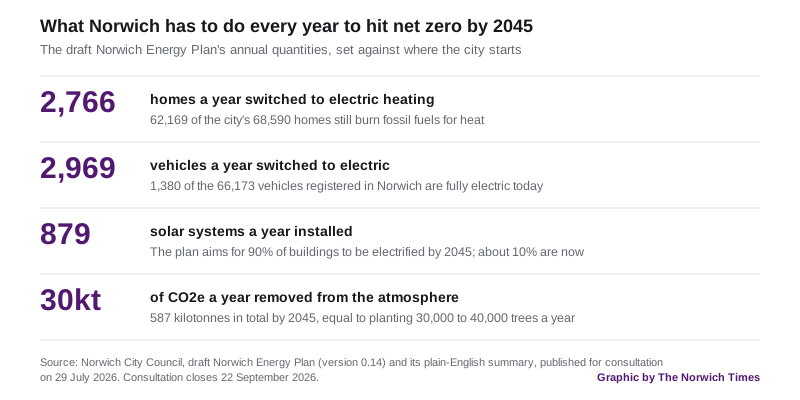
Working from the draft plan’s own arithmetic, reaching the 2045 target means:
- 2,766 homes a year switched from fossil-fuel heating to electric heating such as air source heat pumps
- 2,969 vehicles a year switched from petrol or diesel to electric
- 879 solar systems a year installed
- 30,000 tonnes of CO2e a year removed from the atmosphere, which the council’s plain-English summary equates to planting 30,000 to 40,000 trees annually
The number that drives the urgency
The plan says Norwich has a remaining carbon budget of 2,716 kilotonnes of CO2e, calculated with consultants, which it says prevents the city’s contribution to global warming exceeding 2C. At the current rate of about 445 kilotonnes a year, it says, “the budget would be exceeded within 6.5 years”.
That is why the required pace changes so sharply. Direct emissions from the city fell 56% between 2005 and 2024, an average of 4.1% a year, and the plan notes this happened despite 17% population growth and 75% economic growth over the same period. To hit 2045, the rate has to rise to over 9% a year.
Where the emissions come from
The plan puts the city’s building emissions at 274 kilotonnes of CO2e a year, split as:
- 143.5 kilotonnes from domestic buildings
- 112.9 kilotonnes from commercial buildings
- 17.6 kilotonnes from public buildings
Road transport accounts for about 126 kilotonnes a year. Buildings are 64% of the total and transport 27%, with everything else making up the remaining 9%.
Homes: half the city is below EPC C
There are 68,590 dwellings in Norwich. The plan says 35,783 of them, 52%, hold an Energy Performance Certificate below band C, and that its pathway requires all of them to reach C.
On heating, 6,421 homes (9%) are already electrified, leaving 62,169 to convert. That is where the 2,766 a year comes from. The overall aim is 90% of buildings electrified by 2045.
The plan also expects heating demand to fall by 30%, and it is candid about the split: about a third of that reduction is expected to come from climate change itself producing warmer average temperatures, and the rest from insulation, glazing and better heating controls.
The council commits itself to installing heat pumps, solar panels and efficiency measures across its own 14,000 homes in the city, and across its operational buildings by 2030.
If you are weighing up work on your own house, our Norwich house prices page tracks what local property is selling for.
Charging: 293 points now, up to 11,780 wanted
This is the sharpest gap in the document.
Norwich has 66,173 registered vehicles, of which 54,070 are cars, 7,741 vans, 341 HGVs and 304 buses. Only 1,380 are fully battery electric, with a further 592 plug-in hybrids.
Public charging stood at 293 charge points in January 2026, up from a baseline of 46 in October 2019. The current ratio is about five electric vehicles to every public charge point. Applying that same ratio to a city where 89% of 66,173 vehicles are electric, the plan says, “may mean as many as 11,780 public EVCPs will be required in Norwich by 2045”.
The reason public charging matters so much here is a parking fact. UK Power Networks data cited in the plan indicates 31,761 households in Norwich, roughly half of all households, have access to only on-street parking, so they cannot fit a charger at home. Norfolk County Council, as highways authority, has so far installed 46 on-street charge points across 26 residential streets in the city through the government’s LEVI grant scheme.
Where you can already park, and what it costs, is on our parking in Norwich page.
Trees, and a wording gap worth noticing
Cutting emissions is not enough on its own. The plan requires 587 kilotonnes of CO2e of removals by 2045, about 30 kilotonnes a year.
Norwich’s land currently removes around 7 kilotonnes a year, almost all of it from existing trees. The land itself is 2,610 hectares of built environment, 754 hectares of trees and 555 hectares of grassland.
Two details in the documents do not quite line up, and both are worth raising in a consultation response:
- The plain-English summary says the ambition is “to increase tree canopy cover in Norwich from 20% to 30% by 2035”. The action table in the full draft plan words the same commitment as “pursue 30% tree canopy cover on council land in Norwich”. Those are different promises.
- The summary gives the city area as 3,903 hectares. The land use table in the full plan totals 3,930 hectares.
The plan is also explicit that the city cannot find all its removals inside its own boundary, and will have to look further afield.
What it means for you
The document you are being asked about is a draft, marked version 0.14 and due to go to Cabinet. Nothing in it is settled yet, which is the point of commenting now.
- The deadline is Tuesday 22 September 2026. The survey opened on 29 July and the council says it takes around 10 minutes.
- Respond through Get Talking Norwich. Responses are anonymous unless you choose to give contact details.
- Two documents are published alongside the survey: a plain-English summary and the full draft plan with the targets for buildings, transport and land use. The numbers above are taken from both.
- Questions go to climateaction@norwich.gov.uk.
- Stakeholder organisations are being contacted directly by email, and the council says children and young people will be engaged through sessions in schools.
If your interest is in what any of this costs locally, our Norwich council tax bands page sets out what each band pays this year.
Have your say