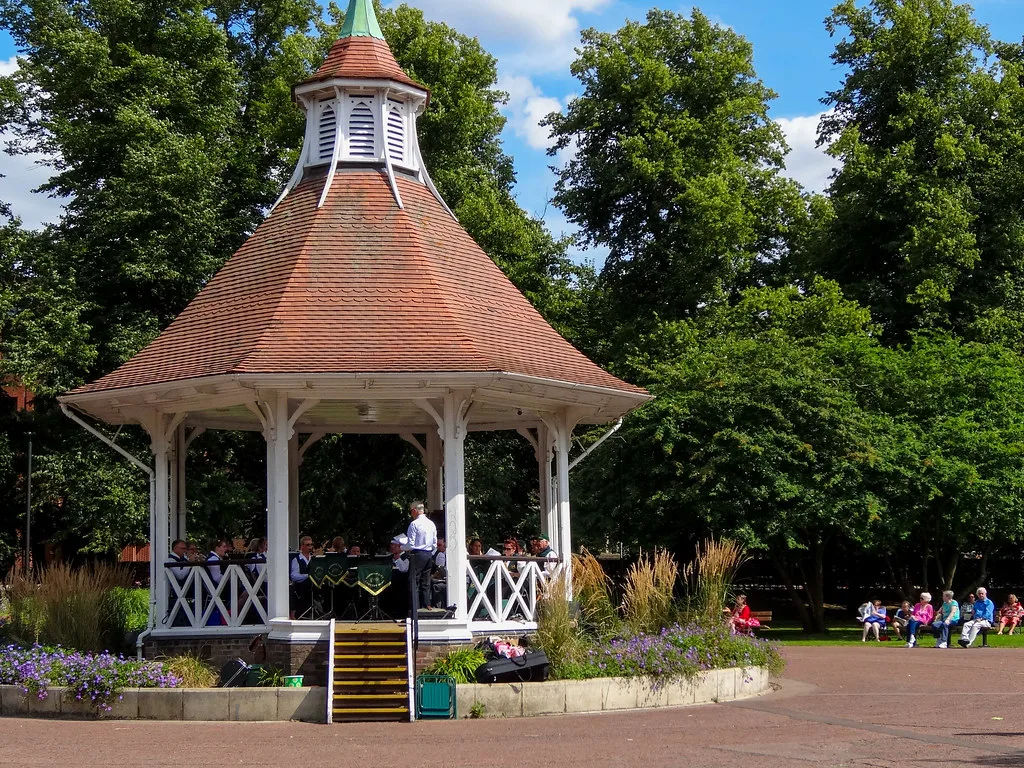

Norwich's 1899 bandstand is back in use after a £315,249 Historic England grant. It has gained a ramp, power points and stage lighting, and anyone can book it.
The timber bandstand in Chapelfield Gardens is back in use after a restoration paid for with a £315,249 grant from Historic England, and it has come back with three things it did not have before: a circular ramp, electricity points, and adjustable lighting for performers.
Norwich City Council announced the completion on 20 August. The structure dates from around 1899 and had been showing what the council called “significant signs of age” after more than a century of use.
What was done
The council’s account of the work names four changes:
- the top of the bandstand was removed for repair and reinstated
- a circular ramp was added, so the stage is reachable without steps
- electricity points were fitted
- adjustable lighting for performers was installed
Planting will be added around the bed of the bandstand over the next few weeks.
The council’s project page for the restoration records that a specialist survey was carried out in May 2025 by Lost Art, a firm that works on bandstands, and that it “identified key issues and provided recommendations”. The restoration contractor was King and Company, working with a conservation architect and a landscape architect.
Where the money came from
The £315,249 is not council money. It came from the Heritage at Risk Capital Fund, which Historic England runs to pay for repairs to heritage that is at risk.
Historic England’s own record of the award says the grant “will enable the comprehensive restoration of the Victorian timber structure”, and gives a reason for choosing Norwich that is worth quoting in full: “The Grade II registered park is an important green space for Norwich residents living with limited outdoor provision.”
Chapelfield Gardens was one of 37 projects across England to share £15 million in the first year of that fund. Historic England also notes that the bandstand work sits alongside a wider programme of proposed improvements to Norwich’s historic parks, supported by the National Lottery Heritage Fund.
The park was laid out 150 years before the bandstand arrived
The gardens are not simply a green space with a Victorian shelter in the middle. Historic England’s list entry for Chapelfield Gardens, which registers the 2.4-hectare site at Grade II, sets out a longer story:
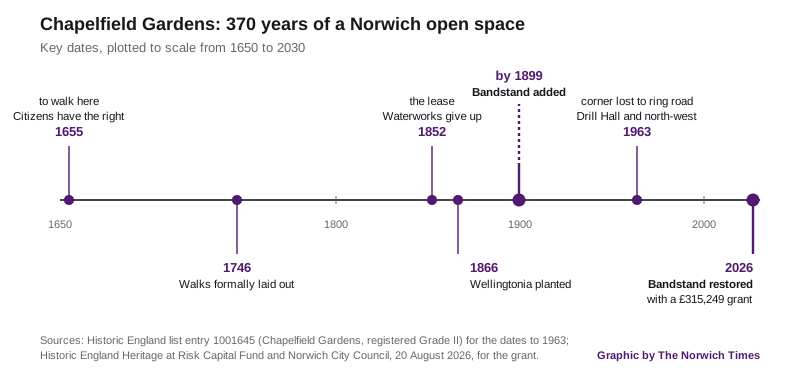
- the land was open to citizens “to walk for their recreation at all times” by 1655
- the three main walks were planted with elm avenues by Sir Thomas Churchman during the 1740s, after the site was formally laid out in 1746
- by the 1840s the site had declined, partly occupied by a waterworks reservoir and water tower
- in 1852 the waterworks company agreed to give up its lease if the corporation laid the land out as a public garden, and in 1866 the Prince and Princess of Wales planted a Wellingtonia to mark the council’s agreement to do so
- the bandstand and a children’s play area had been added by 1899
The listing describes the bandstand itself as timber, with a “plain and fish-scale tile roof”, standing about 70 metres in from the north-east corner entrance. The park was designed by George Alden Stevens, and Historic England calls it the earliest surviving ornamental public open space in Norwich.
It has lost things too. The Drill Hall and the north-west corner of the gardens went in 1963 when the inner ring road was built.
What it means for you
The bandstand is bookable. Anyone who wants to use it should email events@norwich.gov.uk to discuss the request, which the council gives as the only route. There is no online booking form and no published price.
That matters more than it sounds. The power supply and the stage lighting are what turn a shelter into a usable venue for a choir, a school, a band or a community group, and the ramp means a performer who cannot manage steps can now get onto the stage.
Councillor Toby Bolton, cabinet member for parks and open spaces, said the project “not only preserves an important piece of our city’s heritage but also ensures the bandstand can continue to play a central role in the cultural life of Norwich for many years to come”.
One thing to expect if you visit: the grass. The council says on the same project page that summer 2026 “has been one of the driest we have experienced” and that many areas of Chapelfield Gardens “are now devoid of grass”. It plans to reseed large areas over the autumn.
The gardens are enclosed by roads on all three sides, Chapel Field North, Chapel Field East and Chapel Field Road, with pedestrian entrances at each corner and a subway entrance under the ring road. Our guide to things to do in Norwich lists what else is on nearby, and Norwich planning news tracks what is changing in the city.
Have your say