
Black people in Norfolk were stopped and searched 6.3 times as often as white people in 2025/26. In Norwich, searches rose 25% to 972 as the county fell.
Black people in Norfolk were stopped and searched by police 6.3 times as often as white people in the year to March 2026, relative to their share of the county’s population, according to Home Office figures highlighted to The Norwich Times by the charity StopWatch.
Norfolk Constabulary carried out 2,418 stop and searches in 2025/26, the Home Office statistics published on 1 October show. That is 12% fewer than the 2,756 of the year before, and about a third of the 7,382 recorded in 2020/21.
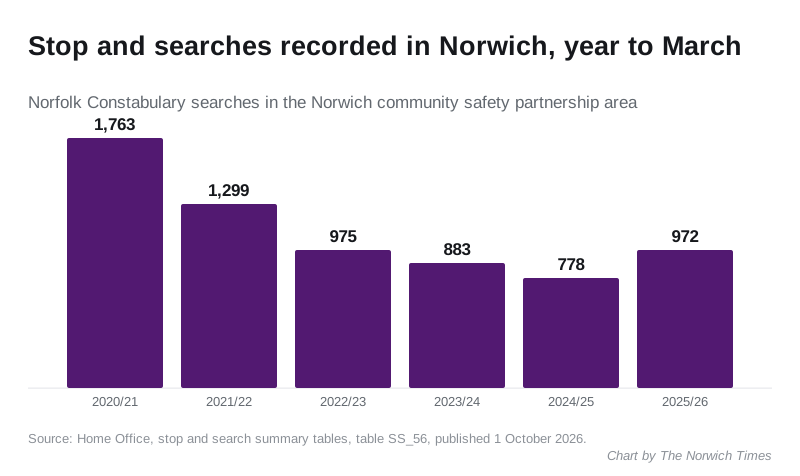
Norwich went the other way. Searches in the Norwich community safety partnership area rose from 778 to 972, a 25% increase, so the city now accounts for four in every ten searches in the county.
Who is searched, and why
StopWatch, a registered charity that monitors stop and search, sent us its summary of the Norfolk figures. We checked each one against the Home Office’s own tables.
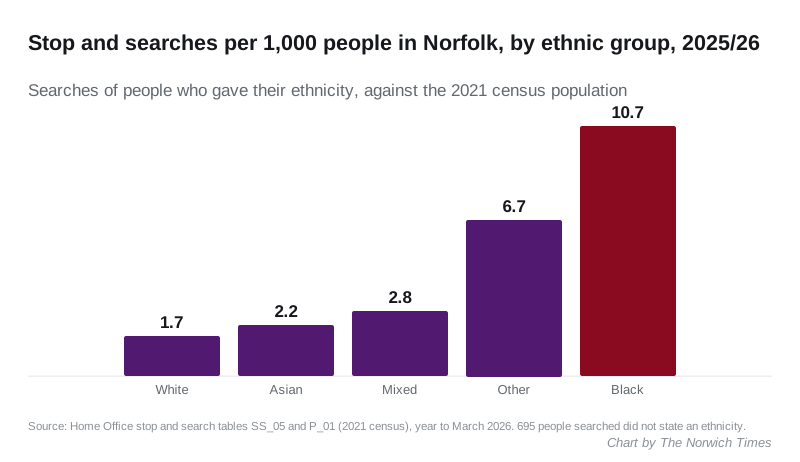
Of the people searched who gave their ethnicity, 90 were Black. Against the 8,376 Black residents counted in Norfolk in the 2021 census, that is 10.7 searches per 1,000 people. For white residents the rate was 1.7 per 1,000 (1,487 searches, 867,152 people). That gap is the 6.3 times figure StopWatch quoted, and the Home Office tables give the same result. People in the census’s “Other” ethnic group were searched at 6.7 per 1,000, which is 3.9 times the white rate, as StopWatch said. The rate was 2.2 per 1,000 for Asian residents and 2.8 for people of mixed ethnicity.
One caution on those rates: 695 of the 2,418 people searched did not state their ethnicity, so the true rates for every group are higher than these figures show.
Drugs were the reason for 1,554 searches, or 64%. Officers searched for offensive weapons 398 times, for “going equipped” 240 times and for stolen property 142 times.
Force was used in 1,021 searches (42%). The Home Office records 962 of them as “other restraint”, a category that includes handcuffs where it is not known whether the person complied. Body worn video was used in 2,360 of the 2,418 searches.
What the searches found
Most searches led nowhere. 1,287 ended with no further action, a little over half, and 532 (22%) led to an arrest. Another 289 ended in a community resolution.
A weapon or firearm was found in 97 searches, 4% of the total, and 79 of those led to an arrest. The weapons found included 64 bladed articles.
Strip searches on the street
Norfolk police carried out 46 full strip searches, exposing intimate parts, during stop and searches in 2025/26, and 18 more in which more than outer clothing was removed.
Two of the full strip searches were of children, both aged 16 or 17. The Home Office records that an appropriate adult was present for both.
For all 46 full strip searches, Norfolk recorded the location as “not known”, so the figures do not show whether they took place at a police station, a home or somewhere else out of public view. A supervisor was consulted for 45 of them and not consulted for one.
Strip searches in custody
A separate Home Office series covers strip searches of people held in police custody. In the year to March 2025, the latest published, Norfolk recorded 575 strip searches in custody, against 15,092 detentions.
- 40 were of children (six aged 13 to 15 and 34 aged 16 or 17), 7% of the total.
- 40 were of adults aged 51 or over, also 7%.
- 53 were of Black people (9%) and 494 of white people (86%). Black people made up about 0.9% of Norfolk’s population in the 2021 census and white people about 95%. On those figures, Black people were strip searched in custody about 11 times as often as white people.
Norfolk’s figures were similar in the two years before: 549 strip searches in custody in 2022/23 and 636 in 2023/24, the Home Office’s year to March 2024 tables show. Ethnicity was not stated for 380 and 407 of them, so those two years cannot be broken down reliably by ethnic group.
StopWatch’s summary gave a total of 8,194 strip searches, 72% of them of white people, which is how it reached a figure of 11.9. The charity has since told us those figures cover 2022/23 and 2023/24, not the latest year. In the breakdown it sent us, the rows behind them are recorded for Essex Police (4,461 and 3,733 strip searches) rather than Norfolk. The Home Office labels the custody figures “official statistics in development” and warns that forces record strip searches differently, so comparisons between forces should be made with care.
Corrected 8 October: StopWatch has clarified that its 8,194 figure covers 2022 to 2024; we have added Norfolk’s own figures for those two years.
What it means for you
The national figures, including every force in England and Wales, are in the Home Office’s stop and search, arrests and mental health detentions release. GOV.UK sets out what police can and cannot do in a search on its stop and search: your rights page.
StopWatch says anyone who has been stopped and searched and needs advice or support, or wants to share their experience, can email support@stop-watch.org. The charity publishes a newsletter rounding up what it calls disproportionate policing practices across the UK, and more about its work is at stop-watch.org.
For crime reported in the city itself, see our latest Norwich city centre crime figures.
Have your say