
The FSCS declared the Norwich-registered adviser in default on 12 August, so former clients can claim up to £85,000. Its liquidation paid creditors nothing.
The Financial Services Compensation Scheme has declared Signpost Financial Planning Limited in default, opening a compensation route for former clients of the advice firm almost six years after it stopped trading. The scheme’s failed firms register records the firm as having failed on 12 August 2026 and gives its Financial Conduct Authority reference number as 575237.
A default declaration is the step that allows the FSCS to pay out. For investment advice the scheme covers up to £85,000 per eligible person, per firm where the firm failed after 1 April 2019. It does not pay for investments that simply fell in value.
It matters here because the company’s own liquidation paid its creditors nothing at all.
What the record shows
Signpost Financial Planning Limited was incorporated on 25 November 2011, with its first registered office at The Coach House, 90 Newmarket Road, Norwich. Companies House lists its business as activities auxiliary to financial intermediation, and the liquidators’ final account gives its principal trading address as The Chancery, Attleborough Road, Little Ellingham, near Attleborough. Its registered office came back to Norwich on 24 September 2020, to King Street House in Upper King Street, and moved in March 2023 to Prospect House on Rouen Road, where it stayed until the company was dissolved.
The firm entered creditors’ voluntary liquidation on 16 September 2020, with Andrew Anderson Kelsall and Lee Anthony Green of Larking Gowen LLP appointed joint liquidators the same day. The regulated part of the business had been sold the previous month, on 7 August 2020, for £109,000, with 15 per cent of the price held back by the buyer for four months.
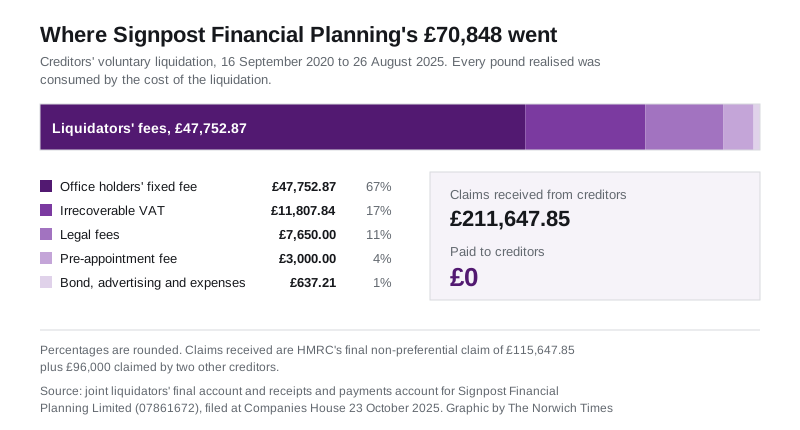
The liquidators’ final account, signed on 26 August 2025 and filed at Companies House on 23 October 2025, sets out what was left. Asset realisations came to £70,847.92 over the five years: £53,342.24 of cash at bank, the £16,440 retained from the sale of the business, £758.49 of trail commission, £300 for the company’s computer equipment, which the director bought, and £7.19 of bank interest.
All of it went on the cost of the liquidation. The office holders’ fixed fee took £47,752.87, irrecoverable VAT £11,807.84, legal fees £7,650 and a pre-appointment fee £3,000, with the remaining £637.21 covering the insolvency bond, statutory advertising, a transcription service and small disbursements. The receipts and payments account closes at nil.
“I have not been able to declare a dividend to unsecured creditors as the funds realised have been used to make payments to meet the expenses of the liquidation,” the liquidator wrote in the final account.
That is a long way from the forecast. The statement of affairs lodged at the start of the case had projected £31,760 available for creditors. HM Revenue and Customs alone submitted a final non-preferential claim of £115,647.85, against the £82,909 the statement of affairs had anticipated, and two other creditors claimed £96,000 between them. Two more, with estimated claims totalling £98,664, never claimed at all. Of the £211,647.85 of claims that were actually submitted, not a penny was paid.
One asset was written off completely. The statement of affairs listed a £10,000 book debt owed by Travltalk Media Limited, which the liquidators expected to realise £1,000. The debtor denied owing anything, entered creditors’ voluntary liquidation on 4 June 2021 and was dissolved on 28 September 2022, paying no dividend to any class of creditor. Nothing was recovered.
Why it took five years
The final account is unusually direct about why the case ran so long. Clients contacted the liquidators after their appointment “to raise concerns regarding the conduct of the director”, claiming that the advice they had received “was not sufficient or in their best interests” and that they had lost significant money on products the company recommended. Those clients complained to the Financial Ombudsman Service and the FCA, and claimed compensation from the FSCS.
The liquidators investigated. The company’s professional indemnity insurers rejected the claims as outside the policy. A second opinion from a specialist solicitor concluded that challenging that decision was unlikely to succeed and would cost in the region of £300,000, so it was not pursued. Separate solicitors reviewed whether the director could be held responsible for investors’ losses and, the account records, “it was established that the director was not liable for the losses to the investors”. A confidential report on the director’s conduct went to the Secretary of State within three months of the appointment, as the law requires in every liquidation.
The case could not close until the FCA cancelled the firm’s Part 4A permissions, which it has now done, and the company was dissolved on 23 January 2026. The FSCS declared it in default just under seven months later.
Creditors had the right under the Insolvency (England and Wales) Rules 2016 to request further details of the liquidators’ fees and expenses within 21 days of receiving the final account, and to apply to court to challenge them within eight weeks. Those periods have passed.
What it means for you
If you took investment or pension advice from Signpost Financial Planning, the FSCS is now the only realistic route to getting money back. The company has been dissolved and there is no dividend to come from the liquidation.
- Claim direct, and free. The FSCS says you do not need a solicitor or a claims management company, and claiming direct means you keep all of any compensation. Its number is 0800 678 1100.
- The limit is £85,000 per eligible person, per firm, because the firm failed after 1 April 2019.
- Poor performance is not covered. The scheme pays for bad advice, and for shortfalls where a firm held your assets, not for investments that lost value on their own.
- The default date helps you. FSCS time limits generally run six years from the loss, but the clock stops at the earlier of the date you first put a possible claim in writing and the date the firm is declared in default, which is now 12 August 2026.
- Dig out the paperwork. Suitability reports, illustrations and annual statements from the time of the advice are what the scheme asks for, and they are harder to find the longer you leave it.
If you have already complained to the Financial Ombudsman Service about the firm, that does not stop you claiming: the ombudsman cannot award against a company that no longer exists, which is precisely the gap the FSCS default declaration fills.
Everything above is taken from the FSCS failed firms register and from documents filed at Companies House. The liquidators’ conclusions are theirs as recorded in the final account, and the FCA’s own findings on the firm are confidential.
More Norwich numbers worth watching: what homes in the city are actually selling for, in our Norwich house prices tracker, and what is being built and refused in Norwich planning news.
Have your say