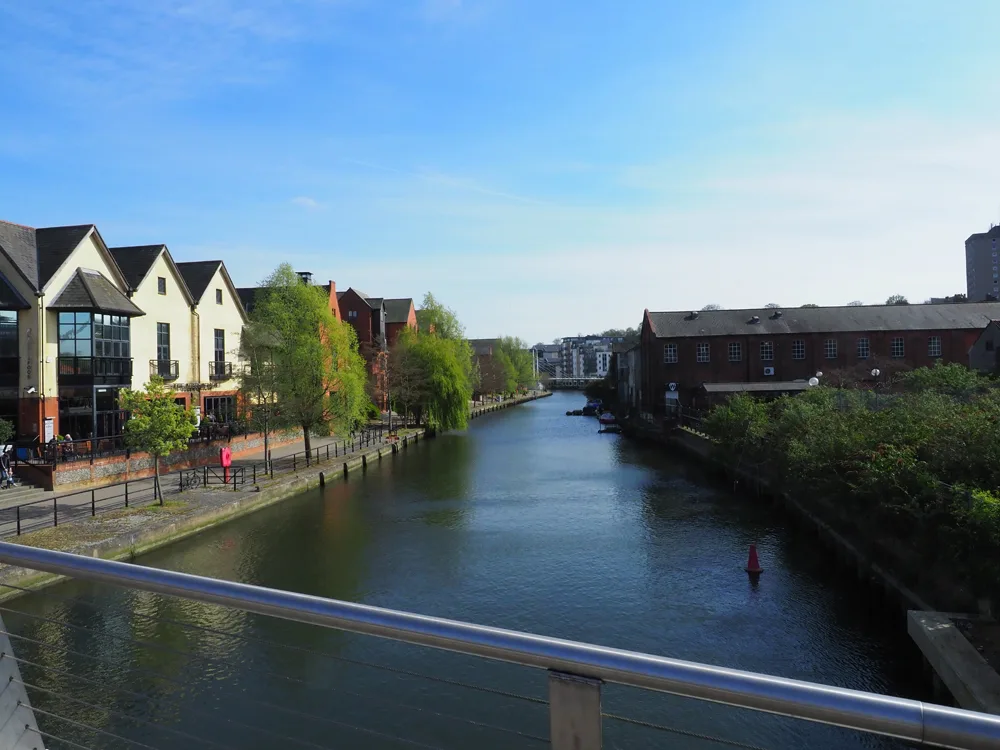

The Wensum at Costessey Mill has averaged 0.75 cubic metres a second this month, a third of normal for August, and 14 abstractors have been ordered to stop.
The River Wensum has run lower through the first half of August than in any August since 1991, according to the Environment Agency’s own gauge on the western edge of Norwich, and 14 licence holders in the Wensum catchment have already been told to stop taking water from it.
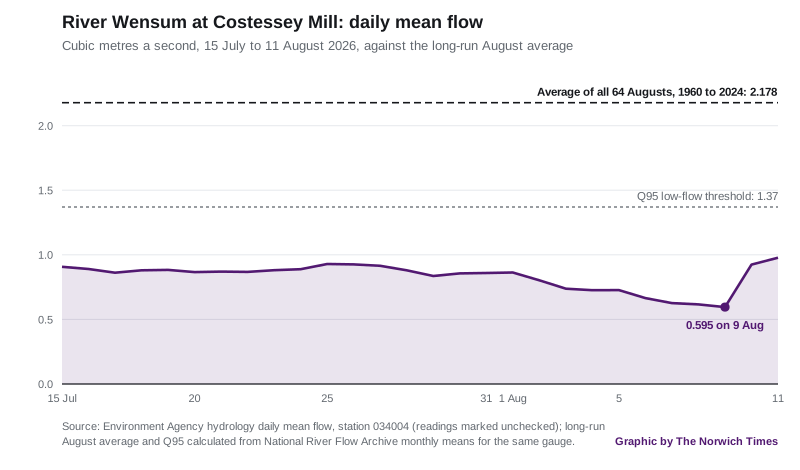
The gauge at Costessey Mill, which measures the river before it reaches the city, recorded daily mean flows falling steadily through the first nine days of the month: 0.863 cubic metres a second on 1 August, 0.665 on 6 August and 0.595 on 9 August. Flow recovered to 0.924 and 0.978 over the following two days. Averaged across 1 to 11 August, the river carried 0.751 cubic metres a second.
That is less than half what the same gauge measured over the same eleven days last year, when it averaged 1.546. It is about a third of what the Wensum normally carries in August. Across the 64 Augusts in the National River Flow Archive record for this gauge, which begins in February 1960, the average August flow is 2.178 cubic metres a second.
Only one August in that entire record has come in below the level the Wensum is currently running at. In August 1991 the monthly mean was 0.516. The next lowest is August 1990 at 0.791, which is already above this month’s running figure, and the drought summer of 1976 recorded 1.0. The river has also spent every day of this month below 1.37 cubic metres a second, the flow the archive records this gauge as exceeding 95 per cent of the time.
Two caveats are worth stating plainly. The 2026 readings are Environment Agency daily means still marked “unchecked”, meaning they are provisional and may be revised, and they cover eleven days rather than a whole month. The historic figures are complete monthly means. The archive also notes that flows at Costessey Mill are influenced by groundwater and surface water abstraction for Norwich and that mill sluices regulate levels there, so the gauge reflects what the city takes as well as what the weather delivers.
Fourteen Wensum abstractors have been stopped
The Environment Agency set out the consequences on 10 August, when the National Drought Group met and 71.3 per cent of England was formally in drought. Its statement records that “14 abstractors in the Wensum catchment, Norfolk, have had to stop due to low water flows and the potential impact on the environment”.
That sits inside a much larger regional squeeze. The same statement puts 1,534 irrigation restrictions in place across East Anglia, and says 302 abstractors in the region “are in the process of having to reduce the amount they can take from rivers by 50 per cent to protect the environment due to exceptionally low flows”. The agency’s weekly drought briefing for 31 July to 6 August describes those as S57 restrictions and confirms East Anglia remains one of the areas formally in drought.
The same briefing records Anglian Water as sitting at drought level 2 in its Fenland, its Norfolk and Norwich, and its Broads water resource zones, a step above the level 1 it reports for Ruthamford, Lincolnshire and Suffolk. Norwich is inside the Norfolk and Norwich zone.
What it means for you
The hosepipe ban already covering Norwich remains in force. Anglian Water’s statutory notice, made under sections 76 and 76A to C of the Water Industry Act 1991 and last updated on 17 July, says restrictions started at 01:01 on Saturday 11 July and “will continue until further notification” across the whole supply area apart from Hartlepool.
Eleven uses are prohibited if a hosepipe is involved: watering a garden, watering plants at home, cleaning a private car or its trailer, cleaning a private leisure boat, filling or maintaining a domestic swimming or paddling pool, drawing water for hot tubs and similar recreational use, filling or maintaining a domestic pond, filling or maintaining an ornamental fountain, and cleaning the walls, windows, paths, patios or other artificial surfaces of a home. Sprinklers, irrigation systems and pressure washers connected to the mains all count as hosepipes, and a “garden” in the notice includes lawns, parks, grass verges, non-commercial allotments and any other green space.
Most of those jobs can still be done with a bucket or watering can, the two exceptions being pools and fountains. Water from a butt, a borehole or grey water is not restricted at all. The notice also allows a hosepipe for food crops at home or on a private allotment where a watering can is not reasonable, for saplings, trees and hedging planted within three years of the ban, for newly laid turf and newly sown grass seed for their first 28 days, and for drip or trickle systems fitted with a timer and a pressure reducing valve that put water straight onto the soil.
Anyone who is physically unable to use a watering can or bucket safely because of a health condition, disability or support need is automatically excepted, and does not need to apply. Customers on Anglian Water’s Priority Services Register are covered automatically, and the notice says the exception still applies to people who are not registered but would be eligible, including some Blue Badge holders. Use of a hosepipe is also unrestricted where it is needed for health and safety, or for the welfare of animals including fish.
Breaking the ban is a criminal offence. The notice states that anyone contravening it “may be liable on summary conviction to a fine not exceeding £1,000”.
For readers planning outdoor days out, our guide to things to do in Norwich has current opening times and prices, and Norwich roadworks and travel covers the closures in place across the city.
Have your say